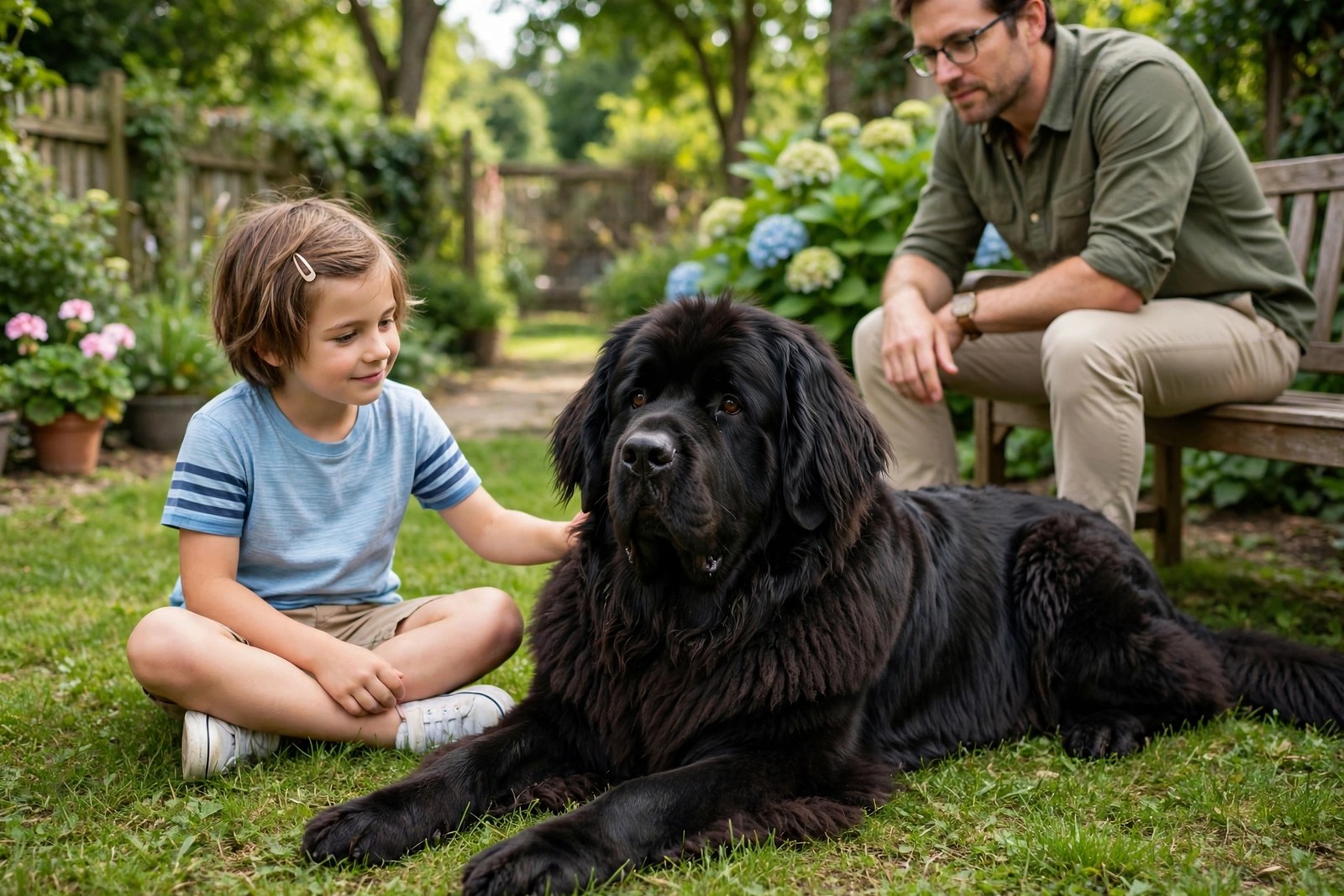
Yes, the reputation is genuinely earned, and understanding why it exists helps you see where its limits sit. Newfoundlands were working water dogs, hauling nets and rescuing people from the sea, and the breed was selected for steadiness under pressure as much as for strength. A typical adult is calm, patient, tolerant of clumsy handling, and noticeably drawn to children, often choosing to lie beside them and staying put through noise and fuss that would drive another dog out of the room. That temperament is a breed tendency, not a guarantee about an individual dog, and it never removes the physics of the animal sharing your house: an adult Newfoundland can weigh well over 100 pounds, stands tall enough to look a small child in the eye, and carries that weight on a body that turns, leans, and greets with its whole frame.
The risks are size risks, not temperament risks
A young Newfoundland who has not yet learned body awareness can flatten a toddler simply by swinging his hindquarters round, backing up, or surging forward to greet someone at the door. A happy tail at small-child head height, a paw lifted in play, or a dog who drops heavily down to lie beside a baby on a mat can all injure without a trace of ill intent. Adolescent Newfoundlands are the peak risk period: nearly full size, still boisterous, and not yet reliable about calming down on cue.
Manage the space rather than relying on the dog's good nature. Use baby gates so dog and small children can be separated quickly, give the dog a settled place to go when children's play gets loud, and keep greetings calm and on the floor rather than letting children rush a dog who is equally pleased to see them. An adult should be within arm's reach whenever a toddler and the dog are together on the ground.
Rules children need to learn
Children must never ride a Newfoundland, climb on his back, or use him as a step or a sofa, however willing the dog appears to be. A tolerant dog who endures being climbed on is not enjoying it, and carrying a child's weight can hurt his back and joints, especially while he is still growing. Teach children not to pull ears, tail, or the loose skin at the neck, not to hug tightly around the neck, never to disturb the dog while he is eating or sleeping, and to let him walk away whenever he chooses to. A dog whose escape route is respected rarely needs to escalate, and children who learn to read a turned head, a yawn, or a dog getting up and leaving are learning the skill that keeps them safe with every dog they will ever meet.
No child, however sensible, should be left alone with a dog of this size.
Water, heat, and everyday handling
Newfoundlands have strong water instincts and webbed feet, and many will head for water with complete confidence. That instinct is not lifeguarding: a dog may crowd, paw at, or try to haul at a swimming child in play, and a child must never be in the water with the dog without an adult present and in charge. Supervise paddling pools at home too, where a large dog climbing in beside a toddler can knock the child under in shallow water.
Day to day, teach children to walk the dog only when an adult is holding the main responsibility for the lead, because a sudden lunge after a squirrel can pull a child off his or her feet. Drool is part of the breed, so supervise contact with babies whose faces sit at slobber height, and watch heat in summer, when a thick-coated giant breed tires fast and children expect the game to continue.
The gentle reputation holds when the household supplies the supervision the size demands: gates, space, taught children, and an adult present. KinsLe Family Sharing keeps that consistent by putting the supervision rules, the dog's greeting routine, and his exercise and heat notes in one shared profile that parents, grandparents, and sitters all read the same way.