
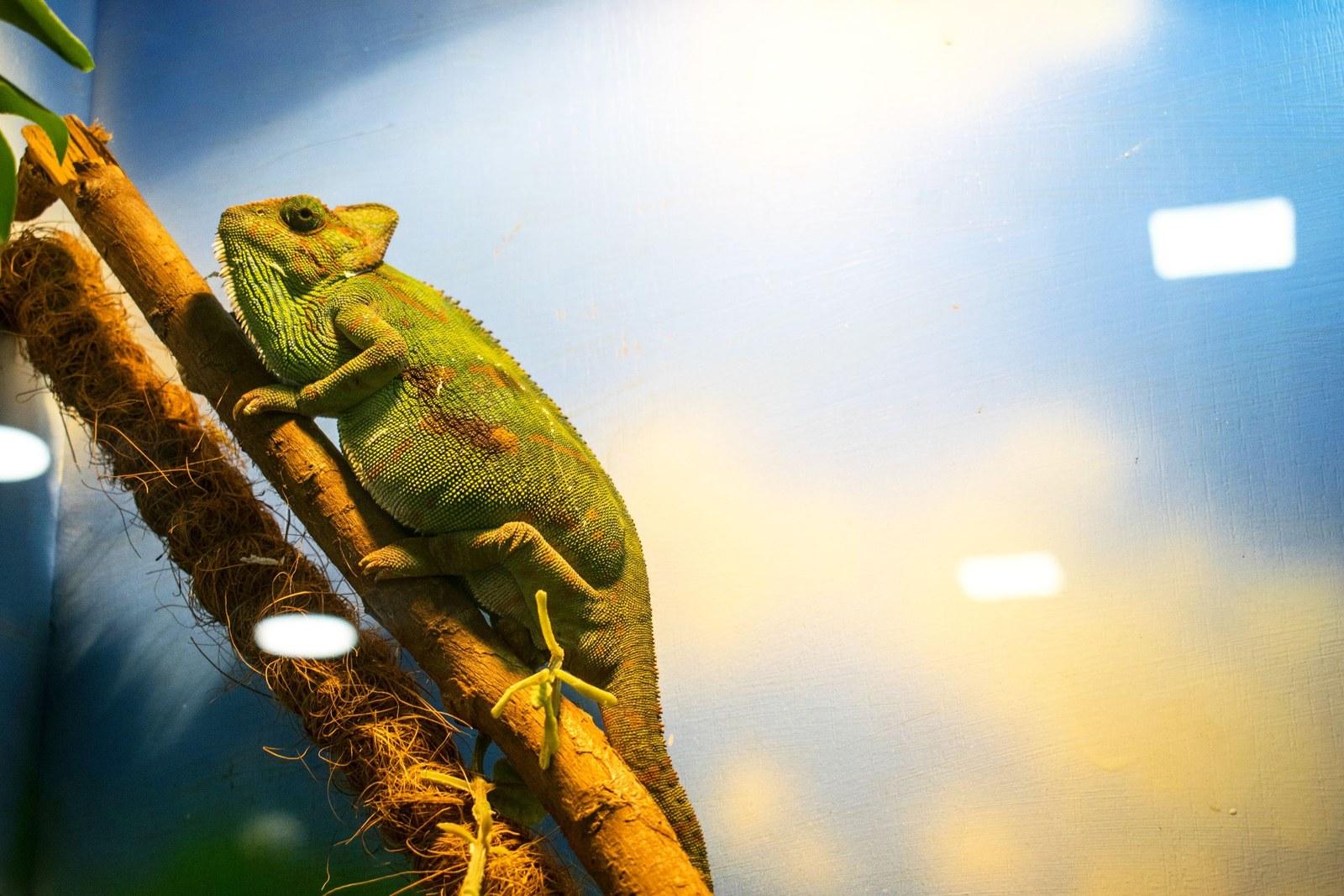
Your chameleon needs three things from its lighting: a UVB light for calcium metabolism, a separate basking light for warmth, and a clear day-night cycle with true darkness at night. Branches should be arranged so your chameleon can climb closer to the lights to warm up or drop lower and into foliage to cool off and escape the rays. Because chameleons live up high, what matters is the temperature and light at the basking branch itself, not down at the enclosure floor.
UVB: the non-negotiable light
Like other sun-loving reptiles, chameleons use UVB to produce vitamin D3 and absorb calcium. Without it, bones weaken and health declines, even with supplemented food. A linear tube UVB fixture spanning much of the enclosure top is the usual choice, positioned at the distance its manufacturer recommends for the species' needs. Veiled and panther chameleons, the species most commonly kept, both need reliable UVB every day.
Remember that UVB output fades with age while visible light does not, so note the install date and replace the bulb on schedule. Mesh tops also filter some UVB, which is another reason to follow the distance guidance for your exact fixture rather than eyeballing it.
Basking heat, measured at the branch
The basking light provides a warm hotspot at the top branch. Place a thermometer probe right at that basking perch, or check it with an infrared gun, because temperatures a few inches lower can be dramatically cooler in a tall, airy chameleon enclosure. Your chameleon should be able to sit at the ideal spot without pressing against a guard or screen close enough to risk a burn. Burns along the back and casque are a known hazard when a chameleon can get too close to an unguarded bulb, so use fixtures and guards designed to keep a safe gap.
Angle matters too. A basking spot slightly to one side lets your chameleon warm up without sitting in the brightest UVB zone the entire time.
A day that ends properly
Chameleons need a consistent rhythm, typically a long lit day followed by complete darkness. No coloured night bulbs, no glowing heat lamps after hours. Night-time temperature drops are natural for many species and part of healthy keeping. A simple timer removes human error from the schedule, keeping lights consistent even when your own routine changes on weekends or holidays.
Position the enclosure away from windows where direct sun could overheat the top of the cage unpredictably, and away from televisions or lamps that stay on late and blur your chameleon's sense of night.
Foliage is part of the lighting plan
Leaves are not just decoration in a chameleon enclosure, they are shade engineering. Dense foliage in the middle and lower zones creates dappled, weaker-light areas where your chameleon can regulate its exposure minute by minute. A chameleon that spends all day pressed to the top screen may be chasing heat or UVB it cannot reach properly, while one that never comes up may find the top too hot or exposed. Watch the pattern and adjust one variable at a time.
If your chameleon keeps its eyes closed during the day, stops eating, or shows weak grip and frequent falls, contact a reptile-savvy veterinarian promptly. Lighting problems and other husbandry issues can sit behind those signs, and they need hands-on assessment.
Recording the setup for anyone who helps
Chameleon lighting has many moving parts: bulb types, install dates, distances, timer settings, and basking temperatures. That is exactly the kind of detail worth saving in KinsLe's Pet Passport, the records packet that holds vaccines, medications, allergies, and documents and can be shared with vets or sitters. A sitter can then reproduce your lighting setup faithfully instead of improvising, and a vet can see precisely how your chameleon is kept. Log the readings in the Pet Passport record on KinsLe — the date a bulb was fitted, hours logged on the lit cycle, and the temperature measured at the basking branch — so a clinician can follow the setup history at a glance.