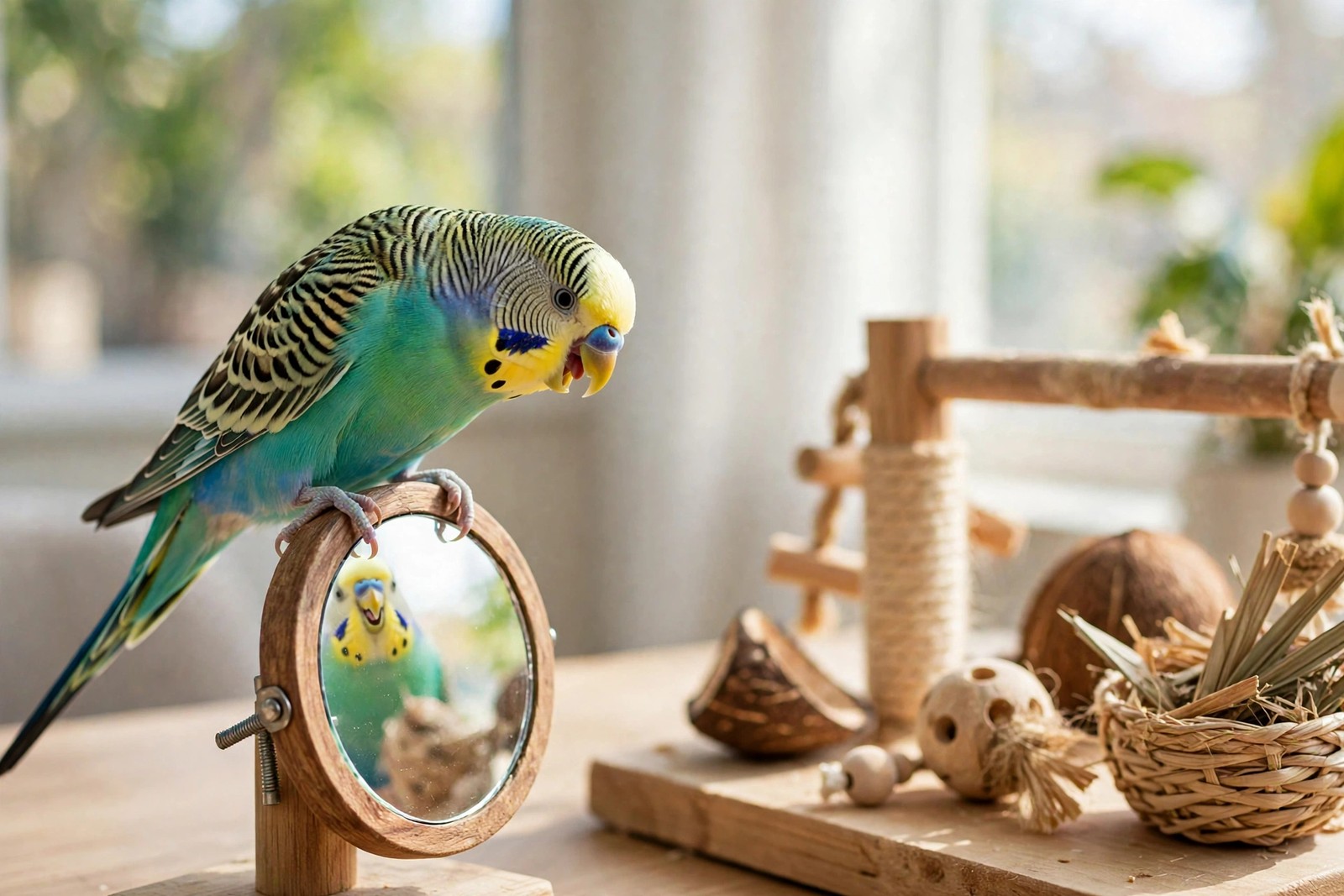
To your budgie, the mirror is not a reflection. Budgies do not recognise themselves in a mirror, so what your bird sees is another budgie: one who faces him, matches his movements, sings when he sings, and never, ever leaves. For a flock animal whose deepest instinct is to stay close to companions, that apparently devoted neighbour is magnetic, and a single budgie will spend hours chatting, head-bobbing, beak-tapping, and singing to it.
A companion who never answers properly
The problem builds inside that one-sided friendship. A courting budgie expects the other bird to respond in kind: to bob back with feeling, accept offered regurgitated seed, and preen beak to beak. The reflection copies shapes but returns nothing real, so a bonded-to-the-mirror bird can swing between excitement and visible frustration, lunging at the glass, calling louder, or trying repeatedly to feed a partner who cannot eat. Some budgies simply enjoy a chat and wander off to play. The mirror becomes a welfare issue when it starts replacing real life: the bird eats less, loses interest in toys and in you, defends the mirror against hands, or spends most of its waking day pressed beside it.
Limiting the mirror without a cold stop
You do not have to ban mirrors on day one, but treat them like a strong treat rather than furniture. Offer the mirror for short, supervised play periods on a play stand instead of leaving it in the cage around the clock, and watch how your bird behaves in the hour after it comes away. If he returns to eating, playing, and interacting with you, short sessions are probably fine. If he calls searchingly, refuses food, or stays agitated, take the mirror out altogether and expect a few unsettled days while he adjusts. Fill the gap on purpose: more out-of-cage time with you, foraging toys that make him work for seed, a radio or household bustle for company sounds, and, if your space and budget genuinely allow it and you want a second bird, a real budgie companion after proper quarantine and introductions.
Company is the underlying need
Mirror obsession is usually a loneliness signal wearing a funny disguise. A budgie left alone in a quiet room for long working days will take the company on offer, and the reflection is always on offer. Before blaming the mirror, check the basics: how many hours of real interaction and out-of-cage time the bird gets, whether the cage sits where household life happens, and whether toys rotate often enough to compete. Replacing even part of that mirror time with training, trick practice, or simply having the cage open beside you while you work usually loosens the fixation within a couple of weeks. Logging the mirror sessions, and who is providing out-of-cage company each day, in KinsLe's Care Teams turns a vague plan to spend more time with your budgie into a rota the whole household can actually follow.