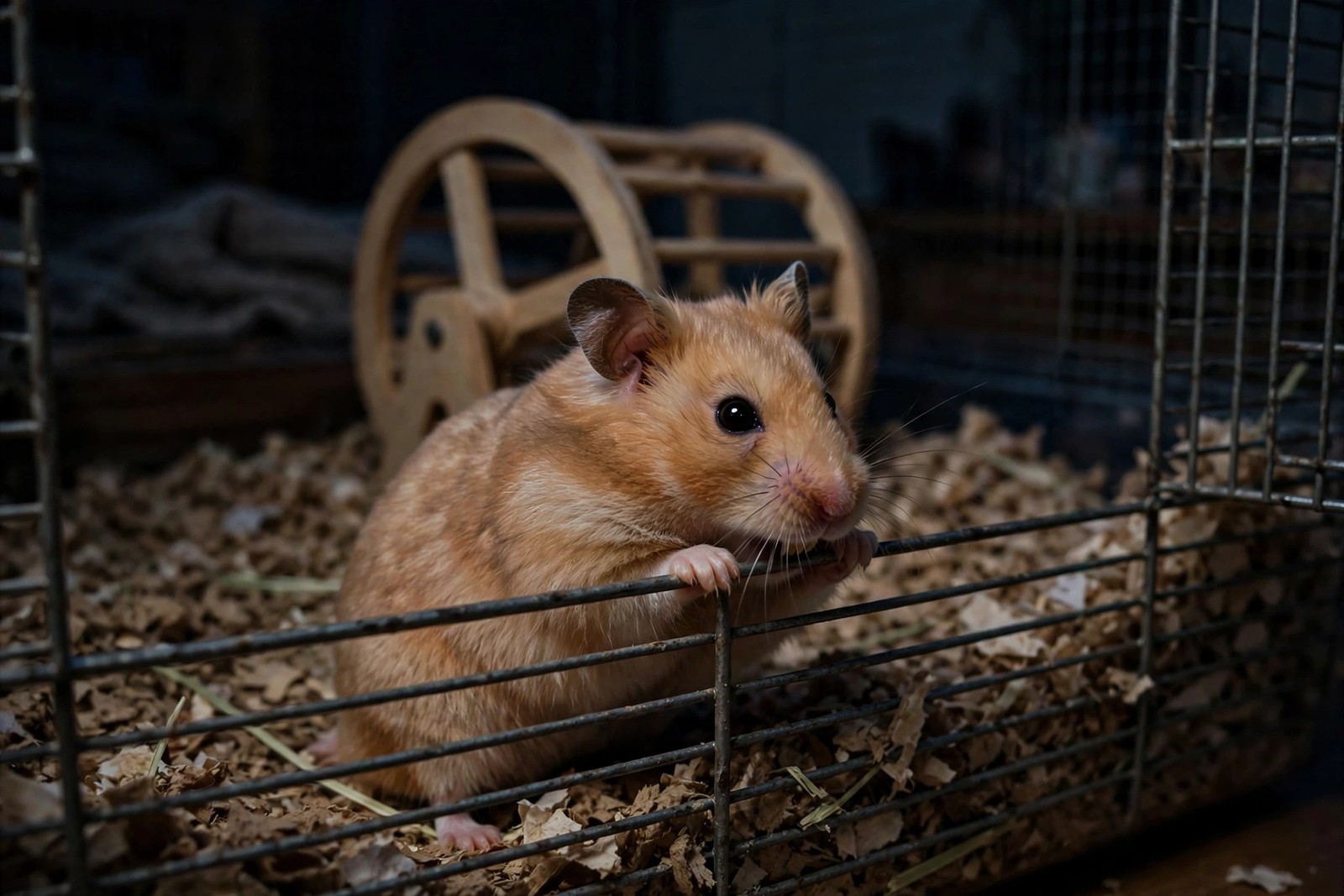
The sound carries through a dark house: a rhythmic clang and rattle as your hamster takes the cage bars in his teeth and chews or tugs at them for long stretches. This behaviour, often called bar biting or bar chewing, is classed by welfare specialists as a stereotypy, a repetitive action produced by frustration rather than by any need the bars themselves meet. Your hamster is not sharpening his teeth in any useful way, and he is not asking for a different product. He is telling you the night is too long for the world he has been given.
The Night-Time Energy Problem
Hamsters are built for distance. Wild hamsters leave the burrow after dark and range widely, gathering food to carry home in their cheek pouches. A pet hamster wakes with the same programme loaded: run, explore, dig, gnaw, forage. If the enclosure is small, the wheel is too small to use comfortably or missing, the bedding is too shallow to burrow in, and dinner arrived in a bowl with no searching required, every one of those drives is still switched on with nowhere to go. The bars, the one feature that promises an outside, get the energy. Learned attention can cement the habit. If chewing reliably produces a human who talks, offers a treat, or lifts the hamster out, the behaviour pays, and a frustrated action becomes a trained one. Teeth play only a small part: hamster teeth do grow continuously and need gnawing material, but a hamster with proper chew material who still attacks the bars is describing frustration, not dentistry.
Why It Is Worth Fixing Properly
Bar biting is hard on the biter. The incisors can wear unevenly, chip, or break; the nose and muzzle rub raw against the bars; and a hamster spending his active hours on a frustration loop is not resting, foraging, or exercising normally. Treat it as information, not naughtiness. Punishment has no place here, and coating bars in bitter substances attacks the symptom while leaving every cause intact.
The Changes That Resolve It
Space is the foundation: the largest enclosure you can manage, ideally a barless, tank-style habitat, which removes the bars from the equation entirely while allowing deep bedding. Aim for a deep layer of bedding across much of the floor so your hamster can dig real burrows, not just rearrange the surface. Add a solid-surface running wheel large enough that his back stays straight while running, since a too-small wheel is one a hamster will abandon for the bars. Then fill the night with jobs. Provide untreated wood chews, cardboard tubes, and hide boxes to shred and remodel. Scatter the evening food through the bedding instead of using a bowl, so finding dinner takes the foraging time it should. Rotate a few toys weekly, offer supervised playpen time in the evening, and keep the enclosure in a room that stays quiet through the day, since daytime disturbance steals the sleep your hamster needs before his shift begins. Many owners also move a persistently noisy setup out of the bedroom rather than shrinking the hamster's world to protect their own sleep.
Watching Whether It Works
Change one or two things at a time and observe for a week; bar biting built over months rarely vanishes in a night, but the sessions should shorten and start later as the enclosure improves. Broken teeth, a sore or swollen nose, weight loss, or a hamster who stops eating needs a veterinarian, ideally one comfortable with small mammals. If the pattern still puzzles you after a week of changes, put a follow-up question to KinsLe's Kimmy; she answers using the KinsLe Answers library.