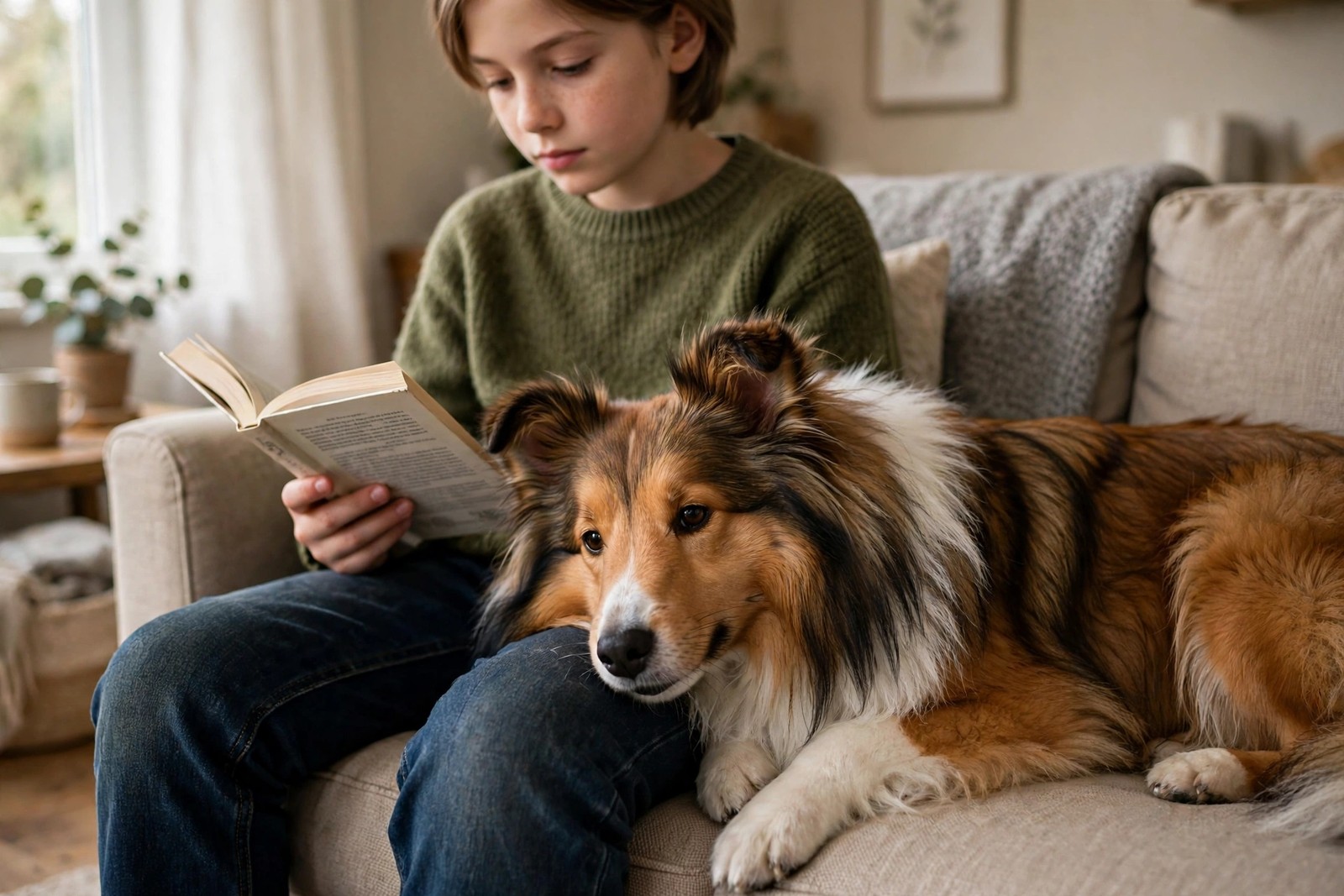
Yes, for the right children. A Shetland Sheepdog in a calm household is often exquisitely gentle: loyal to the point of shadowing its favourite child, soft in play, and happiest quietly included in reading time, garden pottering, and gentle training games. The condition is the household's volume and pace. Shelties are among the more sensitive and reserved herding breeds, and the match fails not through aggression but through a dog who is chronically stressed by the way young children naturally behave.
Why Noise and Speed Are the Problem
Shelties hear everything and worry about much of it. Toddlers shriek at unpredictable pitches, drop toys, fall over, run in bursts, and grab at a passing dog, and each of those ordinary events can send a Sheltie retreating under furniture or barking in alarm. A dog who spends the day braced for the next crash is not enjoying family life, however patient it looks. Children under about five are therefore a hard fit for most Shelties, while a quiet seven-year-old who moves slowly, speaks softly, and lets the dog approach usually becomes exactly the companion this breed wants.
The Herding Element
Shelties were bred to move sheep, and excited children trigger the circuit. Running games can draw circling, chasing, barking, and nipping at heels or clothing, which frightens children and is then misread as naughtiness. Manage it structurally rather than by scolding: football and tag happen away from the dog, the dog practises a settle on a mat during children's active play, and the herding urge is given legal outlets through fetch, flirt-pole games under adult control, and trick training. If heel-nipping appears, stop the running game, redirect to a toy, and lower the excitement rather than letting the chase rehearse itself daily.
Setting Up a Sheltie-Friendly Home
The dog needs a retreat that is genuinely respected: a crate with the door open or a quiet corner bed where no child follows, ever, including for apologies and cuddles. Teach children the Sheltie greeting, which is patience: crouch sideways, hand low, let the dog sniff and choose contact, and stroke the chest rather than reaching over the head. Supervise all contact with visiting children especially, because a Sheltie who knows its own children may find a loud birthday party genuinely distressing, and removing the dog to its quiet room before the party starts is kindness, not exclusion. School-age children can share real care, and brushing that long coat gently on the floor is often where the bond forms.
In a measured, gentle home, a Sheltie and a child can be a devoted pair for the dog's whole life. KinsLe's Family Sharing helps protect that balance by storing the dog's retreat rule, noise sensitivities, and herding-game boundaries in one shared profile that family, babysitters, and party guests can all read in advance.