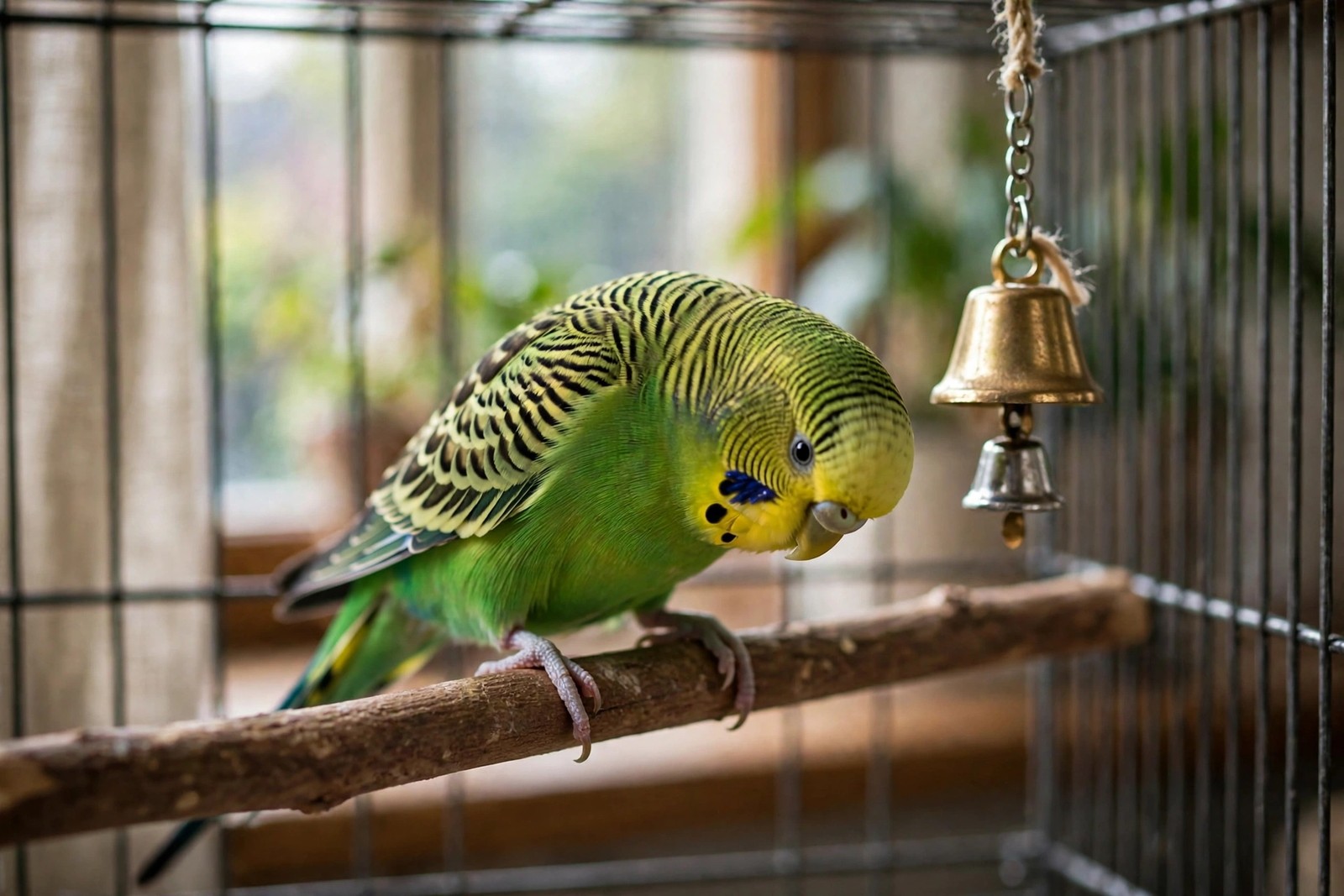
A budgie bobbing his head up and down is usually performing, not malfunctioning. Head-bobbing is part of a male budgie's courtship and excitement display: the head moves in a fast, rhythmic bounce, the feathers on the crown and throat fluff up, the pupils narrow and widen, and the bird often chatters, chirps, and taps his beak against whatever has caught his attention. It is one of the clearest pieces of body language a pet budgie offers, and it is aimed at someone.
Bobbing as courtship
In the wild and in the cage alike, a courting male bobs to impress a mate, and the display often ends with him regurgitating seed and offering it beak to beak. A pet budgie directs the same routine at whoever fills the mate role in his life: a cage companion, a favourite toy, his own reflection in a mirror, or the person he is bonded to. If your budgie bobs at you, bobs at his bell, then tries to feed it, you are watching courtship, not confusion. Females bob occasionally too, but the full performance, with regurgitation, is far more typical of males, especially during hormonal periods when longer daylight can stir breeding behaviour.
Bobbing in young and playful birds
Young budgies bob for connected reasons. Baby budgies bob and beg when they want feeding, and a recently weaned youngster may still bob hopefully at a hand or a food dish. Playful adults bob during excited play, hopping and chattering as part of a general burst of energy, sometimes called the budgie's happy dance by owners. Context tells you which bob you are seeing: bobbing paired with feeding behaviour toward an object is courtship, bobbing in a young bird around mealtimes is often eagerness for food, and bobbing in the middle of active play, with relaxed feathers between displays, is enjoyment.
When bobbing is not the whole story
Bobbing itself is not an illness sign, but what travels with it can be. A budgie who regurgitates repeatedly away from any display, loses weight, passes undigested seed, or goes quiet and fluffed between episodes needs a veterinarian, because that pattern points beyond courtship. Likewise, a bird who bobs while straining, or whose head movement looks like an uncontrolled tremor rather than a deliberate bounce, should be checked rather than assumed to be displaying. For the ordinary courtship bob, no correction is needed, though moving a mirror or favoured toy away for a while can cool an obsessive display. Keeping a short note of when your budgie bobs, what he is bobbing at, and whether feeding follows, in KinsLe's Care Teams record, makes it far easier to show a veterinarian the pattern if the behaviour ever changes character.